

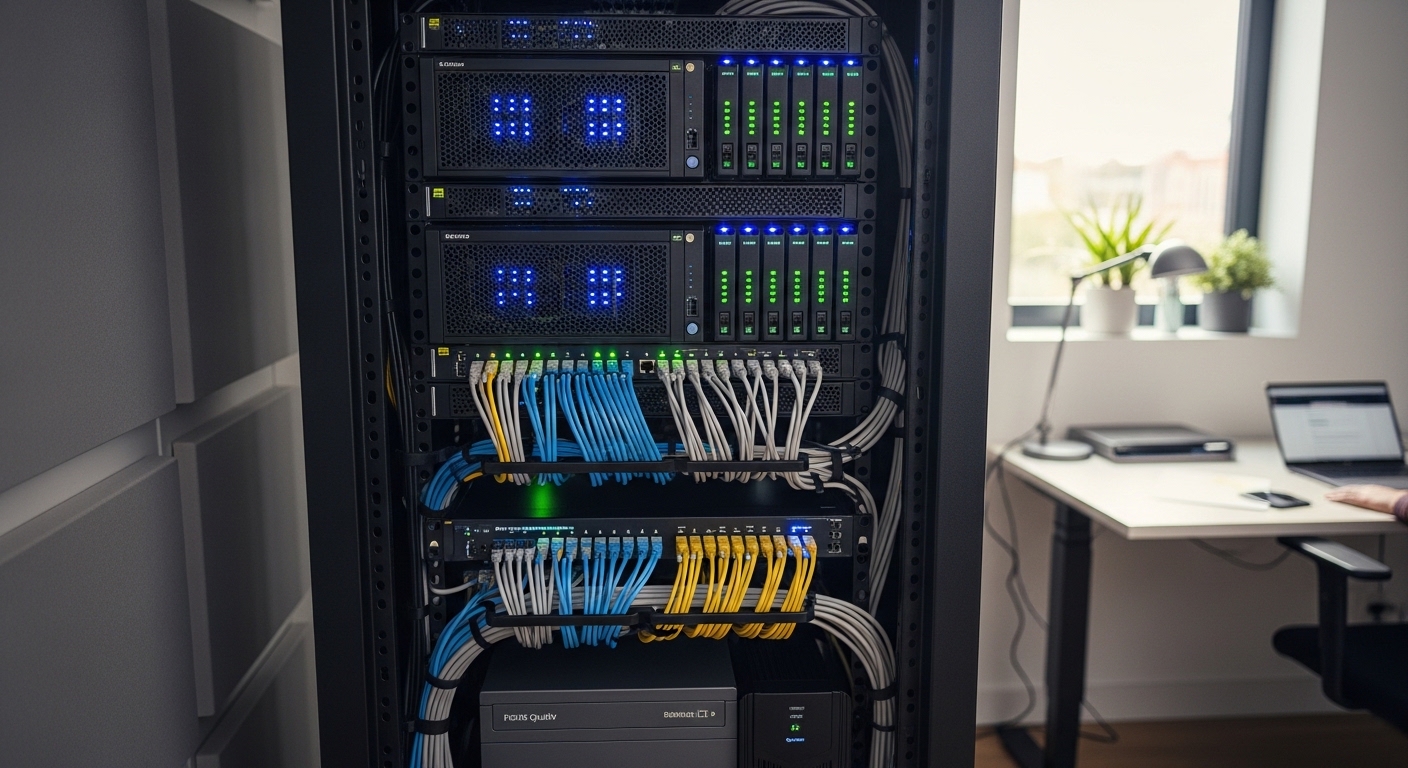
The Evolution of Professional Home Storage
Building a sophisticated home lab represents the ultimate transition from being a casual technology consumer to becoming a specialized systems architect. When you decide to move your data storage to a dedicated server rack, you are embracing professional grade infrastructure that standard desktop units simply cannot match.
This shift is not merely about aesthetics or saving desk space, although those are significant benefits for any modern enthusiast. It is about creating a centralized ecosystem where thermal management and cable organization are prioritized to ensure maximum uptime for your critical services.
The science of rack mounting allows for a unified cooling path, where air flows predictably from the front to the back of the chassis. This thermal efficiency is crucial when you are running intensive applications like Plex media servers or complex Docker containers that generate consistent heat.
In the year 2026, the demand for high density storage has reached new heights as home users begin hosting their own private cloud environments. Utilizing a rack mounted solution provides the structural integrity needed to support multiple high capacity hard drives without the vibration issues common in plastic enclosures.
Redundancy is the cornerstone of any reliable home lab, and these servers offer advanced RAID configurations to protect against drive failure. By choosing one of the best rack mountable nas servers for home lab environments, you ensure that your digital life is shielded from hardware catastrophes.
Furthermore, these systems often feature expansion slots that allow your laboratory to grow alongside your technical skills. Whether you need faster networking or dedicated NVMe cache, the modular nature of rack equipment provides a clear path for future upgrades.
Optimizing Your Server Rack Airflow
Effective cooling is the primary reason why many professionals prefer rack mounted units over their tower counterparts. The horizontal orientation allows for larger cooling fans that can move more air at lower rotational speeds, which significantly reduces noise.
You should consider how the placement of your NAS within the rack affects the overall temperature of your other components. Placing storage units at the bottom or middle of the rack usually provides the best balance for thermal distribution throughout the enclosure.
Quick Buying Guide
Before investing in a rack mounted NAS, you must accurately measure the depth of your existing server cabinet. Many home lab enthusiasts use short depth racks that are designed for wall mounting and might not fit full sized enterprise servers.
Check the specifications for the mounting depth to ensure the chassis will not hit the rear rails or obstruct cable management arms. Selecting a shallow depth chassis can save you from the frustration of an incompatible hardware purchase.
Connectivity is the next critical factor to evaluate, as 1GbE ports are quickly becoming a bottleneck for modern flash storage. Look for servers that offer 2.5GbE or 10GbE SFP ports to take full advantage of high speed networking in your home office.
If the server does not include high speed ports natively, ensure it has an available PCIe expansion slot. This allows you to add network interface cards or even hardware transcoding cards for your media library later on.
The choice of processor will determine how many concurrent tasks your NAS can handle without lagging. For basic file storage, an ARM based processor is highly energy efficient and keeps operating costs low over time.
However, if you plan to run virtual machines or heavy databases, you should prioritize AMD Ryzen or Intel Core processors. these chips provide the computational power necessary to handle complex calculations and multiple user requests simultaneously.
Memory capacity is another vital metric, especially for users who want to experiment with ZFS file systems or deduplication. Ensure the NAS supports ECC RAM if data integrity is your absolute highest priority during long term operations.
Finally, consider the noise levels of the included fans, as some enterprise units are designed for data centers rather than homes. You might want to look for models that allow for fan speed customization through the software interface to keep your workspace quiet.
The 7 Best Rack Mountable NAS Servers for Home Lab
Explore the top rated rack mounted storage solutions designed to elevate your home laboratory to professional standards.
1. Synology RackStation RS822 Plus
The Synology RackStation RS822 Plus features a robust 1U chassis that radiates a sense of industrial reliability. Its build quality is exceptional, utilizing high grade metals that prevent chassis flex when the unit is fully loaded with four hard drives. The front panel is clean and functional, offering easy access to hot swappable bays and clear LED indicators for system health.
Technical performance is driven by an AMD Ryzen V1500B quad core processor, which provides a stable foundation for the DiskStation Manager operating system. This unit excels at multi tasking applications, allowing you to run surveillance software alongside your primary file backups without experiencing significant latency. The inclusion of four 1GbE ports offers basic connectivity, though the real power lies in the PCIe expansion slot for 10GbE upgrades.
This server is best for users who prioritize software stability and a user friendly interface above raw hardware specs. While the initial cost is higher than some competitors, the ecosystem of Synology apps makes it a premier choice for professionals. The main drawback is the lack of native 10GbE ports, which requires an additional investment for high speed networking.

Expanding Your Storage Capacity
As your data grows, you may find that four bays are no longer sufficient for your entire library. Many of these units support expansion enclosures that connect via high speed cables to add more drive slots without replacing the main unit.
2. QNAP TS 435XeU
The QNAP TS 435XeU is specifically engineered for space constrained environments thanks to its short depth design of only 11.4 inches. This allows it to fit into small wall mount cabinets or shallow racks that are common in home office setups. The build is compact yet sturdy, featuring a sleek black finish that blends perfectly with other professional networking gear.
On the performance side, this model includes two 10GbE SFP ports and two 2.5GbE ports right out of the box. This makes it one of the most cost effective ways to implement high speed networking in your home lab without buying extra cards. It utilizes a Marvell OCTEON TX2 quad core processor that is optimized for high throughput and efficient data encryption.
This unit is perfect for the networking enthusiast who wants 10GbE speeds on a strict budget. It handles high speed file transfers beautifully, though the ARM processor might struggle with heavy virtualization tasks. It is an excellent choice for a dedicated backup target or a high speed media repository.

3. Asustor AS6704RS
The Asustor AS6704RS stands out with its focus on modern flash storage integration within a traditional 1U rackmount form factor. The design feels contemporary, and the internal layout is highly optimized for both air circulation and ease of maintenance. It features four drive bays that are easily accessible, alongside a build that feels premium and durable for long term use.
Inside, the Intel Celeron N5105 quad core processor provides excellent hardware transcoding capabilities for 4K video content. A unique feature of this model is the inclusion of four M.2 NVMe slots, which can be used for extreme speed caching or dedicated storage volumes. The dual 2.5GbE ports provide a solid baseline for network performance that surpasses standard gigabit speeds.
This NAS is the ideal selection for media server enthusiasts who need powerful video processing and fast cache. The Asustor Data Master operating system is flexible and supports a wide range of third party applications through its App Central. Some users may find the interface less polished than Synology, but the hardware value is difficult to ignore.
Managing Peripheral Devices
When setting up your rack, you might need to connect various mouse devices or keyboards to a local console. Using a KVM switch allows you to control multiple servers using a single set of wired or wireless mouses for maximum efficiency.
4. Synology RackStation RS1221 Plus
The Synology RackStation RS1221 Plus is a powerhouse 2U server that manages to maintain a compact depth while offering eight drive bays. The extra height allows for larger, quieter fans that maintain optimal temperatures even under heavy computational loads. The construction is solid and professional, designed to handle the weight of eight enterprise capacity hard drives without any structural issues.
The AMD Ryzen V1500B processor returns in this model, providing the same reliable performance seen in the smaller 822 Plus model. With eight bays, you can implement RAID 6 configurations to protect against the simultaneous failure of two drives, which is vital for large data sets. The server also supports ECC memory, which helps prevent data corruption during long term server operation.
This is the definitive choice for the serious data hoarder who needs a large number of bays in a shallow rack. It offers the perfect balance between storage density and physical footprint in a home environment. The primary downside is the higher power consumption compared to the 4 bay units, but that is expected given the increased capacity.

5. QNAP TS 873AeU
The QNAP TS 873AeU is a high performance 2U rackmount NAS that features a shallow depth of only 11.7 inches. Its design is focused on maximum density, packing eight drive bays into a chassis that fits in almost any rack. The build quality is top tier, with a rigid frame and high quality components that indicate a long service life in a demanding lab.
Performance is where this unit truly shines, powered by an AMD Ryzen V1780B quad core processor that reaches speeds up to 3.35 GHz. It comes standard with dual 2.5GbE ports and two M.2 PCIe slots for NVMe SSD caching, ensuring that data bottlenecks are a thing of the past. The PCIe Gen3 slot allows for further expansion, such as adding a 25GbE card for extreme networking experiments.
This server is best for virtualization power users who need to run multiple resource intensive VMs on their NAS. The combination of a powerful Ryzen chip and flexible storage options makes it a versatile beast for any technical project. The only caveat is that the advanced features come with a steeper learning curve than more basic models.
6. TerraMaster U4 423
The TerraMaster U4 423 is a budget friendly 1U rackmount NAS that brings professional features to the entry level market. The chassis design is simple and utilitarian, prioritizing function over flashy aesthetics, which many lab owners appreciate. It provides four drive bays with a sturdy mounting system that ensures your drives stay secure and vibration free during operation.
At its core is an Intel Celeron N5095 quad core processor that delivers surprisingly strong performance for its price bracket. It features dual 2.5GbE ports, which are becoming the new standard for modern home networks and provide plenty of bandwidth for high definition streaming. The system supports up to 32GB of RAM, making it quite capable of running Docker containers and lightweight virtual machines.
This model is the best pick for budget conscious beginners who are just starting their rack mount journey. It offers all the essential features of a professional NAS without the enterprise price tag. While the software ecosystem is not as mature as QNAP or Synology, it is rapidly improving and offers great value for the money.

Securing Your Data with Backups
No matter which NAS you choose, always remember that RAID is not a backup solution. You should implement a 3 2 1 backup strategy where you keep three copies of your data on two different media types, with one copy stored offsite.
7. QNAP TS 464eU
The QNAP TS 464eU is another excellent short depth 1U NAS that focuses on multimedia and speed. Its design is sleek and features a front facing HDMI 1.4b port, allowing you to connect it directly to a monitor or TV. The build is typical of QNAP high standards, offering a compact and thermally efficient enclosure that fits perfectly in small home office racks.
It is powered by an Intel Celeron N5095 processor and features dual M.2 slots for NVMe caching or high speed storage pools. The dual 2.5GbE ports provide excellent connectivity, and the inclusion of USB 3.2 Gen 2 ports allows for fast data transfers from external drives. This model also supports hardware accelerated encryption, ensuring your data stays private without sacrificing system performance.
This unit is specifically tailored for home theater integration and fast local storage for creative professionals. The ability to output video directly to a display makes it unique among most rackmount units. However, users who don’t need the HDMI functionality might find better value in other QNAP models with more networking ports.

Comparison
Choosing the right server requires a side by side look at the technical capabilities and intended use cases for each model.
| Product Name | Key Feature | Best For | Price Range |
|---|---|---|---|
| Synology RackStation RS822 Plus | DSM Ecosystem | Software Stability | Premium |
| QNAP TS 435XeU | Dual 10GbE SFP | Network Speed | Mid Range |
| Asustor AS6704RS | Quad M.2 Slots | SSD Caching | Mid Range |
| Synology RackStation RS1221 Plus | 8 Bay Compact | Large Capacity | High End |
| QNAP TS 873AeU | Ryzen V1780B | Virtualization | High End |
| TerraMaster U4 423 | Intel Quad Core | Budget Lab | Affordable |
| QNAP TS 464eU | HDMI Output | Media Center | Mid Range |
Final Verdict
After evaluating the technical merits and real world performance of these servers, the Synology RackStation RS1221 Plus emerges as the best overall choice for a dedicated home lab. Its eight drive bays provide the perfect amount of headroom for future expansion, while the compact depth ensures it fits into the majority of residential server racks. The combination of AMD Ryzen power and the industry leading DiskStation Manager software creates a user experience that is both powerful and incredibly reliable.
For those who are specifically looking for high speed networking at an accessible price point, the QNAP TS 435XeU is the most logical runner up. The inclusion of native 10GbE SFP connectivity in such a shallow chassis makes it an unbeatable value for modern home networks. Ultimately, your choice should depend on whether you prioritize the sheer software polish of Synology or the aggressive hardware specifications offered by QNAP and Asustor.