

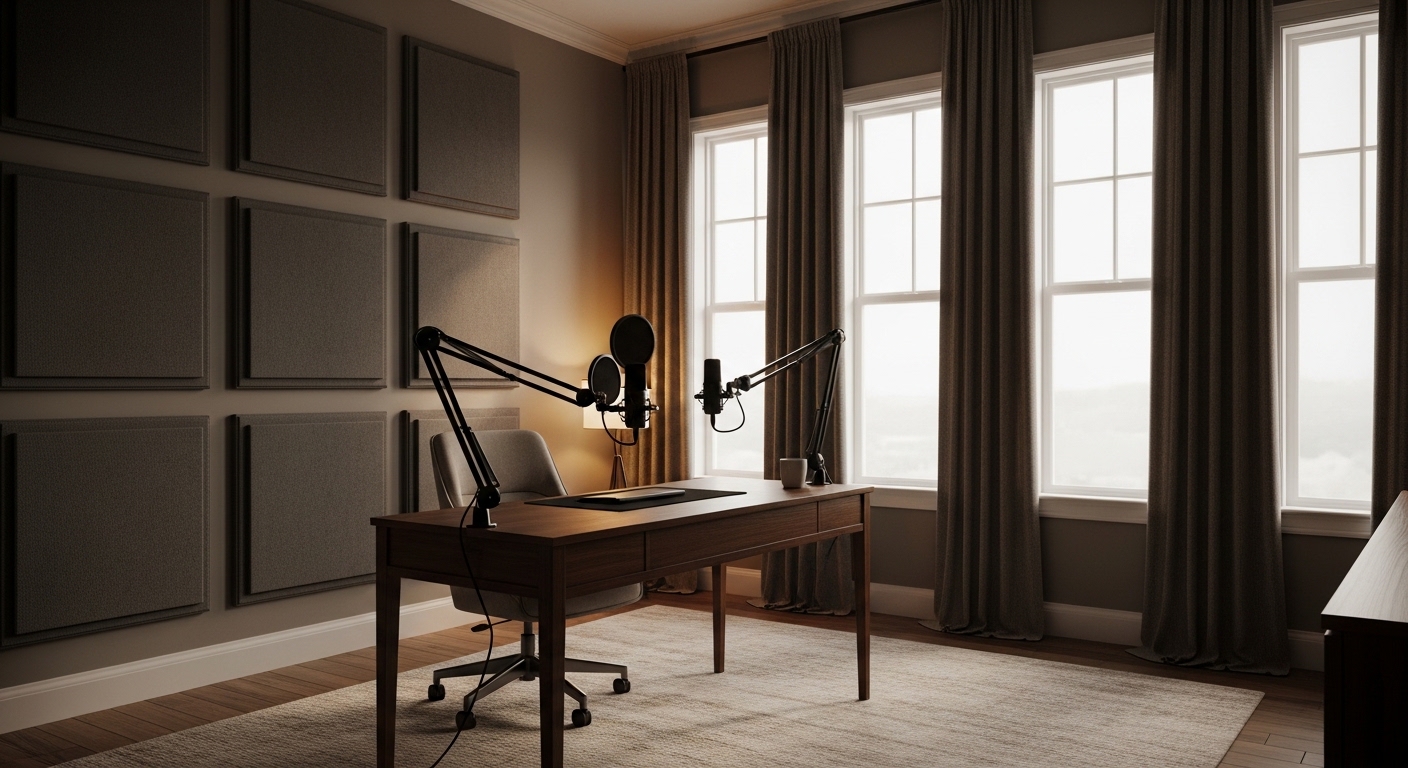
The Importance of Sonic Quality in Professional Settings
Visual clarity is only one half of the remote communication equation. Many professionals overlook the critical role of audio in their daily virtual interactions.
A hollow or echoing voice can distract listeners and diminish the impact of your message. Learning how to improve home office acoustics for video ensures your voice remains clear and authoritative.
Sound waves behave much like light waves by bouncing off hard surfaces. When your voice hits a bare wall, it reflects back into your microphone with a slight delay.
This phenomenon creates what we call reverb or echo. Proper acoustic treatment eliminates these reflections to provide a dry and professional sound profile.
Understanding the Basics of Sound Absorption
The first step in any acoustic journey involves understanding how materials interact with sound. Hard surfaces like glass and concrete are the enemies of clear audio quality.
These materials reflect energy back into the room rather than absorbing it. To fix this, you must introduce porous materials that trap sound energy effectively.
Acoustic foam and rockwool are common choices for this specific purpose. These materials convert sound energy into tiny amounts of heat through friction within their fibers.
When you reduce the amount of bouncing sound, your microphone captures only the direct signal from your mouth. This leads to a much cleaner audio feed for your audience.
The Concept of Noise Reduction Coefficients
When shopping for acoustic materials, you will often see a specific rating called NRC. This stands for the Noise Reduction Coefficient of a product.
The scale typically runs from zero to one. A rating of one means the material absorbs all sound hitting its surface.
For a home office, you should look for materials with a rating of at least zero point seven. This ensures that the bulk of reflections are successfully neutralized.
Higher density materials generally perform better at absorbing lower frequencies. This is vital if you have a deep or resonant voice naturally.
Evaluating Your Current Room Echo
Before you spend money on expensive panels, you must diagnose the specific issues of your room. Every office has a unique sonic signature based on its dimensions.
The simplest diagnostic tool is the clap test. Stand in the center of your room and clap your hands loudly once.
Listen for a ringing sound or a metallic flutter that follows the clap. If you hear a distinct tail to the sound, your room needs significant acoustic treatment immediately.
You can also record yourself speaking while sitting at your desk. Play the recording back through high quality headphones to hear what others hear.
Focus on whether your voice sounds distant or muddy. These are signs that reflected sound waves are interfering with your primary vocal signal.
Identifying the Primary Reflection Points
Sound travels in a straight line until it hits an object. The points where sound first bounces off a wall are called primary reflection points.
In a standard home office, these are usually the walls to your left and right. The ceiling and the surface of your desk also act as major reflectors.
Treating these specific areas provides the biggest improvement for the least effort. You do not need to cover every square inch of your walls.
Strategic placement is far more effective than random coverage. Target the areas at ear level where reflections are most likely to occur.
Choosing Between Different Acoustic Materials
There are several types of products available for those wondering how to improve home office acoustics for video. The most common option is acoustic foam panels found in many home studios.
Foam is lightweight and very easy to install with adhesive strips. However, thin foam is only effective at absorbing high frequency sounds like hissing.
If you want a more comprehensive solution, consider mineral wool panels. These are much denser and can tame mid range frequencies that foam might miss.
Fabric wrapped panels offer a more professional and aesthetic look for your office. They come in various colors and patterns to match your interior design.
Another option is the acoustic cloud which hangs from the ceiling. This is perfect for rooms with high ceilings or hard flooring surfaces.
The Role of Sound Diffusion
Absorption is not the only way to manage sound in a workspace. Sometimes, a room can feel unnaturally dead or claustrophobic if you absorb too much sound.
Diffusion involves scattering sound waves in different directions. This prevents echo without removing all the energy from the room.
Diffusers are often made of wood and have varying depths. They make a small room sound much larger and more natural on recordings.
Mixing absorption and diffusion creates a balanced environment. This balance is ideal for professional video presentations and long meetings.
Managing External Noise Pollution
Acoustic treatment is different from soundproofing. Treatment improves the sound inside the room, while soundproofing blocks external noise from entering.
If you live near a busy street, external noise can ruin your video calls. You must address the weakest links in your room, which are usually windows and doors.
Heavy soundproof curtains are an excellent starting point. These curtains use dense inner layers to dampen outside traffic noise significantly.
You can also use weather stripping to seal gaps around your office door. Even a small gap can allow significant noise to leak into your workspace.
Mass loaded vinyl is a heavy material used to add density to walls. This is a more permanent and intensive solution for noisy environments.
The Impact of HVAC and Computer Fans
Internal noises also contribute to a poor acoustic environment. Air conditioning units and loud computer fans create a constant background hum.
This hum is often called the noise floor of your room. A high noise floor masks the clarity of your speaking voice.
Try to move your computer tower further away from your microphone. Use dedicated microphone stands to isolate the mic from desk vibrations.
If possible, turn off noisy appliances during important video calls. Reducing the noise floor is a foundational step in audio improvement.
Strategic Placement of Furniture
You might already own items that can help improve your acoustics. Bookshelves filled with books act as natural sound diffusers and absorbers.
The uneven surfaces of the books scatter sound waves effectively. Placing a large bookshelf on the back wall of your office can help immensely.
Area rugs are also essential if you have hardwood or tile floors. A thick rug prevents floor reflections from reaching the microphone from below.
Soft furniture like a fabric sofa can also absorb a significant amount of sound. Position these items in corners to catch low frequency energy.
Even heavy blankets can be used as a temporary solution. Hanging a blanket behind your camera can improve your vocal presence during a call.
Taming the Desk Surface Reflections
Many people forget that their desk is a giant reflecting plate. Sound bounces off your desk and directly into your microphone from below.
Using a large felt desk mat can help soften these reflections. It also provides a softer landing for your arms and equipment.
Positioning your microphone closer to your mouth reduces the desk influence. When the mic is close, you can lower the input gain significantly.
Lower gain means the microphone is less sensitive to the room reflections. This is one of the most effective tricks for better sound.
Budget Considerations for Sound Treatment
Improving your home office acoustics does not have to cost thousands of dollars. You can achieve great results on a budget with DIY solutions.
Building your own panels using wooden frames and rockwool is very cost effective. You can wrap them in breathable decorative fabric to save money.
If you have a medium budget, pre made foam kits are widely available. These kits provide a standard set of panels for basic room coverage.
Professional grade treatments are for those who want the absolute best quality. These include custom tuned bass traps and architectural diffusers.
Always prioritize the primary reflection points if your budget is limited. It is better to have two high quality panels in the right place than ten cheap ones in the wrong place.
Investing in Bass Traps
Corners are where sound energy tends to accumulate. This can lead to a boomy or muddy sound in your recordings.
Bass traps are specialized absorbers designed to sit in corners. They are much thicker than standard panels to handle long sound waves.
Adding just two bass traps in the front corners of your room makes a huge difference. Your voice will sound much tighter and more defined.
This is especially important in small rooms where low frequencies build up quickly. Consider these a priority for professional audio setups.
The Role of Software and Digital Tools
Physical treatment is the best solution, but software can help. Many video calling apps now include built in noise suppression features.
These tools use artificial intelligence to identify and remove background noise. They are great for removing steady hums like fans or traffic.
However, software often struggles with heavy room reverb and echo. It can make your voice sound robotic or watery if pushed too hard.
Use software as a final polish rather than a primary solution. The goal is to improve the raw audio before it ever reaches the software.
In the year 2026, we expect digital tools to become even more sophisticated. But even the best AI cannot fix a poorly treated room perfectly.
Using Virtual Sound Checks
Consistency is key when you are maintaining a professional image. Use a dedicated sound check tool before every major presentation.
Most modern platforms allow you to record a short clip to hear the quality. This allows you to make quick adjustments to your environment or mic position.
Check for any new sources of noise like a ticking clock or a humming light. Small details can distract your audience from your important message.
A quick check ensures that your acoustic efforts are actually working. It builds confidence in your technology and your presentation skills.
Conclusion on Home Office Acoustics
Mastering how to improve home office acoustics for video is a journey of small improvements. You do not need to become an acoustic engineer to see results.
Start by identifying your reflection points and adding soft materials to the room. Use rugs, curtains, and strategic panel placement to kill the echo.
Remember that audio is the primary way your ideas are communicated. Investing in your sound is an investment in your professional reputation and clarity.
By following these steps, you will create a space that sounds as good as it looks. Your colleagues will notice the difference in every single call you join.
A quiet and treated room also helps you focus on your work. Sound management is ultimately about creating a better environment for productivity and communication.